℠℠
SID™
SafetyInDemolition
SID LogoThis site SID SafetyInDemolition has been sharing demolition information since 08/14/2006. Any one with an interest in demolition may find this site useful to develop their knowledge of demolition. Consider demolition and safety in parallel to development of this knowledge. You are responsible for reading the Site Disclaimer and by using the site you are agreeing to the disclaimer. If you disagree with the Site Disclaimer than quit using the site. Phase VII an internal goal latest revision is 07/27/2026. We recommend only using https:// for browsing linked sites. Minor updates and corrections are ongoing.

SID LogoResponsible AI in Service of Demolition Professionals

SID advocates the use of Responsible AI and the AI Principles promoted by leading industry developers and technology partners. These principles guide how search, digital tools, and web platforms should operate in support of demolition professionals.
Across all SID domains, demolition professionals remain the center of judgment, interpretation, and decision making. Technology and AI exist to support, strengthen, and extend their expertise — not to replace it.
SID Logo
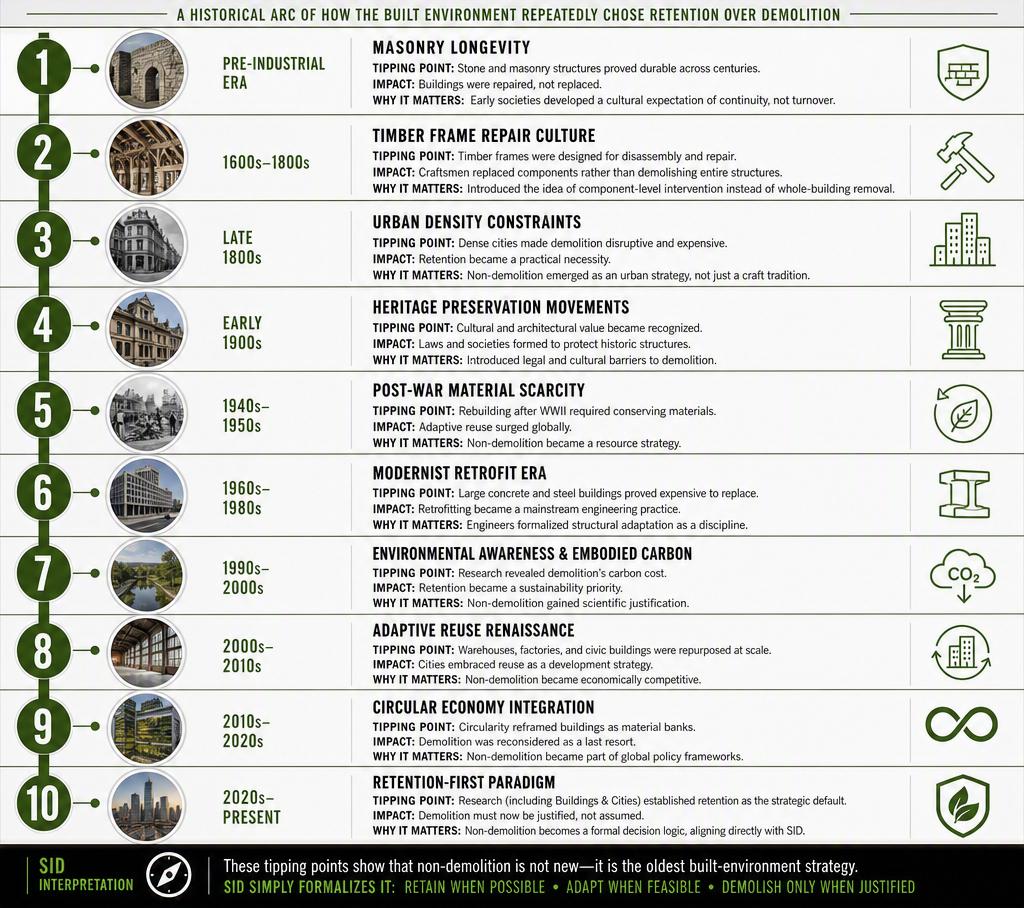
Non - Demolition Tipping Points: The Evolution from Retention to Strategy

“Concept and direction by SID Logo ; image generated with Microsoft Copilot.”
SID Vision- Non-Demolition: Retention, adaptive reuse, and refurbishment represent the strategic counterbalance to demolition.This topic explores how choosing retention over demolition-when safe and feasible-preserves embodied carbon, cultural continuity, and human-centered value within the built environment. Below is a SID aligned Comparative Paradigm Table contrasting the three dominant decision paradigms in the built environment: Linear, Circular, and Retention First. SID's Interpretation of the Three Paradigms are:
Linear Paradigm
A legacy model where demolition is directed, planned, and executed as the natural end of a building’s life. It prioritizes project flow over environmental or human continuity.
Circular Paradigm
A sustainability driven model focused on material recovery and reuse. Demolition still occurs, but it incorporates shifts from disposal to regeneration.
Retention First Paradigm
A decision logic paradigm that reframes demolition as a conditional outcome. It prioritizes retention, adaptive reuse, and refurbishment as the strategic default. This paradigm is the closest to SID’s core philosophy: Demolition is the intentional, evidence based decision to remove a structure, made only after evaluating alternatives, risks, and directives. The physical act is the execution of that decision-not the demolition itself.

SID Logo
SID Comparative Paradigm Table — Linear vs Circular vs Retention First
Dimension
Linear Paradigm
Circular Paradigm
Retention-First Paradigm
Core Logic
Build→ Use→ Demolish
Build→ Use→ Recover→ Reuse→ Recycle
Retain → Adapt → Reuse → Demolish only if necessary
Default Directive
Demolition is inevitable
Materials should re enter the loop
Demolition should be avoided unless justified
Primary Question
“How do we demolish?”
“How do we recover value?”
“Should we demolish at all?”
Value Definition
Economic efficiency and project completion
Material recovery, lifecycle extension
Human, environmental, cultural, and socio economic continuity
Environmental Posture
High waste, high embodied carbon loss
Reduced waste through recovery loops
Maximum preservation of embodied carbon through non demolition
Socio-Economic Impact
Disruption is accepted as part of the cycle
Disruption mitigated through reuse pathways
Disruption minimized by retaining structures and community continuity
Decision Architecture
Linear sequencing: Plan → Demolish → Dispose
Circular sequencing: Recover → Reuse → Recycle
Conditional sequencing: Retain → Adapt → Refurbish → Partial Demo → Full Demo (last)
Role of Demolition
Central and expected
Necessary for material recovery
Last resort; only justified when retention fails
Human-Centered Experience(HCE)
Secondary to project logistics
Considered through reuse and reduced waste
Central; prioritizes continuity, cultural memory, and human impact
Risk Posture
Risk managed through demolition planning
Risk managed through material pathways
Risk managed through avoiding demolition and preserving stability
Strategic Outcome
Predictable end of life demolition
Regenerative material loops
Preservation first built environment transitions
SID Alignment
Opposite of SID’s safety first logic
Compatible with SID’s lifecycle reasoning
Strongly aligned with SID’s evidence based decision logic
Privacy Policy
SID SafetyInDemolition does not intentionally collect personal information from visitors. Standard log files may record IP addresses, browser type, platform type, referring pages, exit pages, and general click trends. This information is used solely for routine site administration and performance monitoring. No personal information is collected or used beyond these standard technical logs.
Cookies may be used, either temporarily or on an ongoing basis, to support site functionality and improve loading performance. You may allow or remove cookies through your browser settings at any time.
This site contains links to government agencies, private organizations, and public websites. Each of these sources maintains its own Privacy Policy and Terms of Use.
SID SafetyInDemolition is not responsible for the content, practices, or privacy policies of any external sites, and you are responsible for reviewing their policies when visiting them.
This Privacy Policy may be updated at any time. Please review it periodically when using this site.
SID LogoLogo, Trademarks, and Copyright
The following names, marks, and images—including their associated logos and visual identities—are claimed as service marks (SM) and trademarks (TM) of Safety In Demolition L.L.C., SafetyInDemolition, SID SafetyInDemolition, Elements of SID, SID Scholar, SID Intelligence, SID Digital First Framework, SID Long Tail Demolition, SID AI, SID Sphere, SID Digital First Sledgehammer, SID Vision and all related site branding and imagery.
All website content, including text, graphics, images, conceptual frameworks, and all rights related to text and data mining, machine learning, artificial intelligence training, or similar technologies, are the exclusive property of Safety In Demolition L.L.C.
© 2006–2026 Safety In Demolition L.L.C. All rights reserved and protected.